Vous entrez dans un magasin, et hop ! vous vous emparez de cette barre chocolatée sans réfléchir. Ce n’est pas un hasard. C’est une stratégie bien rodée. Les commerçants savent que si vous devez chercher un produit, vous ne l’achèterez probablement pas.
Les détaillants placent les produits à hauteur des yeux car cette zone verticale privilégiée, située entre 122 et 152 cm du sol, correspond au regard naturel des consommateurs adultes. Ce placement stratégique maximise l'attention visuelle, minimise l'effort physique et augmente significativement le volume des ventes de produits à forte marge.

Quelle est la hauteur des yeux dans le commerce de détail ?
La plupart des marques pensent que le design se résume à de jolies couleurs. C'est faux. Il s'agit de capter l'attention du client pendant une fraction de seconde avant qu'il ne s'en aille.
En point de vente, la zone optimale de présentation des produits se situe à hauteur des yeux, entre 122 et 137 cm du sol, correspondant au champ de vision direct du consommateur moyen. Les produits positionnés dans cette « zone privilégiée » génèrent généralement les meilleurs taux de vente, car ils facilitent la reconnaissance immédiate de la marque et incitent à l'achat impulsif.
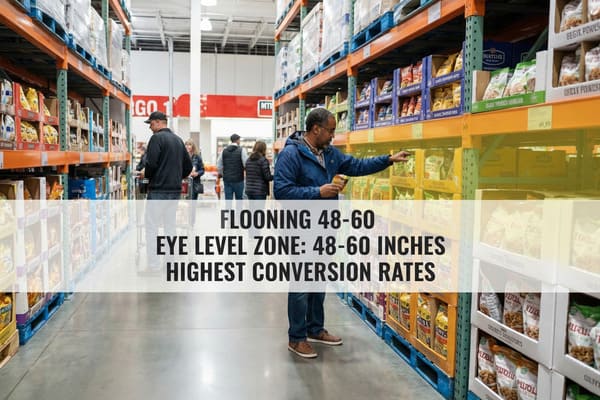
Anatomie structurelle de la « zone d'impact »
Il faut qu'on parle de la « zone critique », ou comme je l'appelle à l'usine, la ligne « tout ou rien ». Je me dispute tous les jours avec les designers à ce sujet. Ils adorent placer les logos tout en haut d'un écran de 183 cm (72 pouces) . Mais voilà la dure réalité : la consommatrice moyenne en Amérique du Nord mesure environ 1,63 m (5 pieds 4 pouces) . Si votre message principal flotte à 1,80 m (6 pieds) de , elle ne le verra jamais. Son regard est droit devant elle, pas vers le plafond.
J'ai appris ça à mes dépens il y a quelques années. Nous avions conçu de magnifiques présentoirs de sol imposants pour une marque de snacks. Ils paraissaient majestueux sur le rendu CAO. Mais une fois installés dans un magasin test Walmart, les ventes sont restées au point mort. Pourquoi ? Parce que l'encart « Appel à l'action 1 » était imprimé à 165 cm (65 pouces) . Les clients passaient devant sans même le remarquer, leur regard étant attiré par la zone entre leur poitrine et leurs yeux. La réunion avec le client a été pénible, et nous avons dû réimprimer les en-têtes à mes frais.
Nous appliquons désormais la règle de la « Carte thermique de la hauteur humaine 2 ». Le produit phare, ou la saveur principale, doit être placé exactement entre 127 et 137 cm du sol. Il s'agit du « Niveau d'achat à hauteur des yeux 3 ». Tout ce qui se trouve en dessous de 76 cm correspond à la « Zone d'ajustement 4 » : c'est là que vous placez les sacs de recharge lourds ou les articles en vrac que les clients chercheront. Mais qu'en est-il des articles d'achat impulsif à forte marge ? S'ils ne sont pas situés entre 127 et 137 cm, ils sont invisibles. Il ne s'agit pas seulement de hauteur ; c'est une question d'ergonomie. Un client ne devrait pas avoir à se tordre le cou ou à plier les genoux pour payer. S'il doit s'accroupir pour lire l'étiquette, la vente est déjà perdue.
| Zone verticale | Plage de hauteur (pouces) | Plage de hauteur (cm) | Engagement des acheteurs | Type de produit idéal |
|---|---|---|---|---|
| Zone d'étirement | > 72" | > 183 cm | Très faible | Surstock / Signalétique |
| Niveau des yeux | 48" – 60" | 122 – 152 cm | Le plus haut (la « zone dorée ») | Forte marge / Impulsivité |
| Niveau tactile | 30" – 48" | 76 – 122 cm | Haut | Meilleures ventes / Articles de base |
| Zone de perron | < 30" | < 76 cm | Faible | Articles volumineux / lourds |
Lors de la conception de votre structure, je suis inflexible quant à la hauteur minimale de 127 cm (50 pouces). Je mesure précisément la distance entre le sol et le bord de l'étagère principale sur le prototype. Si elle est de 117 cm (46 pouces), on la rehausse. Si elle est de 147 cm (58 pouces), on l'abaisse.
Que signifie « à hauteur des yeux » dans le monde des affaires ?
C'est une simple question de calcul. La hauteur des yeux correspond au « niveau d'achat ». Si vous n'êtes pas à cette hauteur, vous payez un loyer pour un espace qui ne vous rapporte rien.
En commerce, le positionnement stratégique des produits (à hauteur des yeux) consiste à prioriser financièrement les références à forte valeur ajoutée afin d'optimiser la rentabilité au mètre carré. Les distributeurs exploitent cet emplacement privilégié en rayon pour générer des achats impulsifs, facturant souvent aux marques des frais d'emplacement élevés pour ces produits très visibles, contrairement aux rayons inférieurs.

Analyse stratégique des coûts du positionnement en rayon
Dans le commerce de détail, la « hauteur des yeux » n'est pas qu'une question de géométrie ; c'est un véritable atout. Ce n'est pas un hasard si les marques paient des sommes astronomiques pour que leurs boîtes de céréales se retrouvent en milieu de rayon. Mais voici le secret que mes clients, spécialistes des présentoirs en carton, utilisent pour contourner le système : un présentoir de sol crée une artificielle . Lorsque vos produits sont relégués en bas des rayons, vos ventes en pâtissent. En revanche, un présentoir de sol en carton (FSDU) placé dans l'allée ou près des caisses crée une nouvelle perspective, une « hauteur des yeux » totalement indépendante de la concurrence féroce pour les rayons.
Nous calculons le « Sales Lift 6 » (ROI) en nous basant sur ce mécanisme. Un présentoir autonome augmente généralement les ventes de 400 % par rapport à un rayon classique, simplement parce que nous maîtrisons la hauteur. Pourtant, je constate que les marques gâchent constamment cette opportunité. J’avais un client new-yorkais qui voulait remplir l’étagère à hauteur des yeux de son présentoir avec son accessoire le moins cher et à faible marge. Il pensait : « Il n’est pas cher, donc les gens l’achèteront facilement. » Erreur. Je lui ai dit : « Tu gaspilles l’espace le plus précieux du magasin pour un article à 2 $. » J’étais furieux, car il jetait littéralement de l’argent par les fenêtres.
Le placement à hauteur des yeux est réservé à votre phare celui qui offre la meilleure marge ou la toute dernière innovation à lancer. Nous appliquons la règle des « 3 secondes d'impact ». Vous disposez de trois secondes pour capter l'attention du consommateur. Si cet emplacement privilégié est occupé par un article banal et sans intérêt, c'est un échec. N'oubliez pas non plus le financement des distributeurs ( ou fonds de développement marketing). Souvent, les grandes enseignes comme Target disposent de budgets pour financer ces présentoirs si vous pouvez prouver que vous proposez un produit à forte valeur ajoutée à hauteur des yeux. J'aide mes clients à rédiger le dossier de candidature pour obtenir ce financement, en démontrant que notre conception structurelle garantit une visibilité optimale.
| Stratégie de placement | Coût de la marque | Visibilité | Taux de conversion | Notes |
|---|---|---|---|---|
| Étagère inférieure | Faible / Aucun | Pauvre | 20-30% | Clients « destinés » uniquement. |
| Étagère à hauteur des yeux | Frais de machines à sous élevés | Excellent | 80-90% | Coûteux à entretenir. |
| Présentoir en carton | Moyen (Fabrication) | Supérieur (perturbateur) | 100 %+ (Impulsion) | Évite les frais de rayonnage ; crée un nouveau niveau de regard. |
Je conseille toujours à mes acheteurs de se concentrer sur la marge, et non sur le coût unitaire de l'emballage. Si le fait de placer votre produit haut de gamme à exactement 132 cm (52 pouces) génère 50 ventes supplémentaires par semaine, la structure en carton est rentabilisée dès le deuxième jour. Les 28 jours suivants sont du pur bénéfice.
Quelle est la hauteur des yeux dans un supermarché ?
Les supermarchés sont un véritable champ de bataille. Les rayons sont standardisés, mais pas les clients. Il faut concevoir des produits adaptés à la moyenne, sinon on perd la majorité.
La hauteur des yeux en supermarché correspond à la hauteur de présentation des produits, généralement fixée entre 127 et 137 cm (50 et 54 pouces), afin de s'adapter à la posture naturelle des consommateurs. Cette norme verticale garantit la lisibilité et la facilité de lecture des étiquettes sans que le client ait à incliner la tête ni à modifier sa position.

Anthropométrie et ergonomie visuelle
Entrons maintenant dans le détail de « Planogram Agility 9 ». Les rayons des supermarchés suivent généralement une grille de gondole standard, avec des encoches tous les 2,54 cm (1 pouce) . Mais ce n'est pas parce qu'on peut placer une étagère n'importe où qu'on doit le faire. J'ai mentionné la règle des 127-137 cm (50-54 pouces), mais voici un détail important souvent négligé : l'angle « menton relevé ». Sur les étagères inférieures d'un présentoir en carton (en dessous de 76 cm ou 30 ), le produit se trouve pratiquement au niveau des genoux du client. Pour lire l'étiquette, le client doit reculer d'un mètre (un pied) et se baisser. Il ne le fera pas. Il est paresseux.
Pour les supermarchés, nous concevons l'étagère inclinée « Menton relevé ». Les deux étagères inférieures sont inclinées vers le haut d'environ 15 degrés. Cela peut paraître anodin, mais cela oblige le produit à être présenté au client par le haut. J'ai dû une fois mettre au rebut une production de 500 unités car nous n'avions pas anticipé le glissement des bouteilles vers l'avant dû à cette inclinaison ; ce fut un désastre, des bouteilles partout ! Désormais, nous utilisons un revêtement antidérapant « Mop Guard » ou un rebord spécifique pour les retenir avant la production en série.
Tenez également compte de la norme ADA (Americans with Disabilities Act) relative à la portée des produits. Si vous vendez dans de grandes chaînes comme CVS ou Walgreens, ou dans des bâtiments gouvernementaux, vous êtes soumis à des contraintes légales. La portée maximale vers l'avant est de 122 cm (48 pouces) et la portée minimale de 38 cm (15 pouces) . Si votre produit est placé trop haut, vous risquez non seulement de perdre des ventes, mais aussi de ne pas être conforme aux normes d'accessibilité. Si une personne en fauteuil roulant ne peut pas atteindre votre produit, le détaillant pourrait refuser l'ensemble du dispositif d'affichage. Je vérifie ces spécifications avant même de découper l'échantillon blanc.
| Fonctionnalité | Spécifications standard | But |
|---|---|---|
| Hauteur cible | 50" – 54" (127 – 137 cm) | Niveau des yeux primaire pour les adultes. |
| Angle de menton relevé11 | 15 degrés (Étagères du bas) | Détourne le regard des genoux vers les yeux. |
| Portée maximale ADA | 48" (122 cm) | Conformité en matière d'accessibilité. |
| Niveau des yeux de l'enfant | 30" – 36" (76 – 91 cm) | Zone cible pour les jouets/bonbons. |
On ne choisit pas ces angles au hasard. Je les teste. Je place un prototype dans mon showroom et je passe devant à différentes distances pour voir si le logo ressort ou disparaît. Si je ne peux pas le lire à trois mètres, on change l'angle.
Quelle est la hauteur d'un magasin de détail ?
On pourrait croire que tout est possible, mais en réalité, c'est le camion qui nous limite. Et à l'intérieur du magasin, l'éclairage est tellement mauvais qu'on ne voit rien.
La hauteur sous plafond d'un magasin correspond à la distance verticale entre le sol et le plafond, généralement comprise entre 3,6 et 6,7 mètres (12 à 22 pieds) dans les points de vente standards, même si la hauteur des étagères est limitée à 152-183 cm (60 à 72 pouces). Cette limitation permet de garantir une bonne visibilité pour les caméras de sécurité et un éclairage optimal des produits.
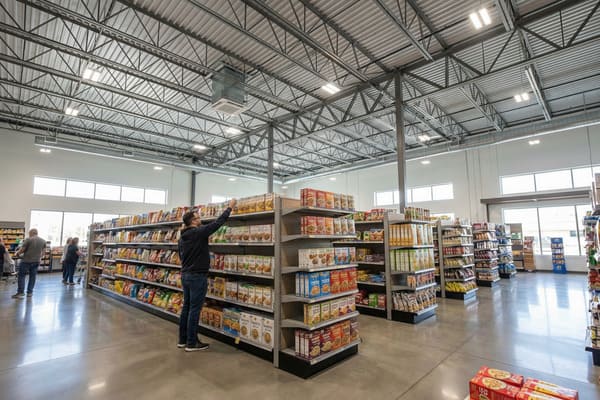
La « zone d'ombre 12 » et le plafond logistique
Voici le point de friction entre la hauteur sous plafond du magasin et la hauteur d'exposition. Un hypermarché Walmart possède des plafonds très hauts, mais l'éclairage y est zénithal. Si je vous conçois une présentation avec des étagères profondes et des parois latérales pleines, l'étagère supérieure bloque la lumière pour l'étagère inférieure. Les produits au milieu se trouvent dans la « zone d'ombre », c'est-à-dire dans l'obscurité totale. Or, les produits sombres ne se vendent pas. Je remédie à ce problème en créant des « fenêtres latérales » ou en utilisant des « doublures intérieures blanches » (du papier blanc brillant collé à l'intérieur des parois) pour réfléchir la lumière du plafond vers le bas. Cela augmente la visibilité de 40 % sans avoir recours à des LED coûteuses.
Mais la véritable « hauteur » à prendre en compte n'est pas celle du plafond du magasin, mais celle du camion. La porte d'un semi-remorque standard américain mesure environ 254 à 279 cm de haut. Or, les transporteurs LTL (Less Than Truckload) cherchent à empiler les palettes sur deux pour maximiser leurs profits. Si votre présentoir sur palette mesure 152 cm de haut, l'empilement sur deux est impossible. Vous venez donc de doubler vos frais de transport.
Je conseille à mes clients de limiter la hauteur de la palette d'expédition (13 pouces) à moins de 122-127 cm (48-50 pouces), si possible. Cela s'intègre parfaitement à l'infrastructure logistique américaine. Si vous avez absolument besoin d'un présentoir de 70 pouces, nous le concevons comme un empilage modulaire ou avec un bandeau rabattable afin qu'il soit expédié plus court et reste bien droit. J'ai vu des acheteurs se voir infliger des surtaxes exorbitantes pour « non empilable » parce que leur concepteur avait prévu un carton de 55 pouces de haut. Évitez cette erreur. De plus, pour les grandes surfaces comme Costco, nous devons respecter la règle « pas de débordement » et leurs limites de hauteur spécifiques afin de garantir la stabilité dans les rayonnages métalliques.
| Source de contrainte | Limite de hauteur maximale | Raison |
|---|---|---|
| Camion semi-remorque américain (LTL) | ~50" (127 cm) (pour l'empilage) | Efficacité du fret / Double empilage. |
| Club Store (Costco) | ~58" (147 cm) (avec palette) | Sécurité des rayonnages / Visibilité. |
| Télécabine standard | 54" – 72" (137 – 183 cm) | Visibilité du magasin / Caméras de sécurité. |
| Effet d'ombre | N / A | Des étagères profondes bloquent l'éclairage zénithal. |
Je tiens une base de données de ces spécifications de détaillants. Si vous me dites que c'est pour Costco, je sais que la limite de hauteur est différente de celle d'un comptoir de supérette. Nous concevons en tenant compte de l'environnement, pas seulement du produit.
Conclusion
Placer les produits à hauteur des yeux n'a rien de magique ; il s'agit simplement de réduire les frottements. Qu'il s'agisse d'incliner une étagère du bas ou de trouver la hauteur idéale de 127 cm, l'objectif est de faciliter l'achat.
Souhaiteriez-vous que je crée un rendu 3D structurel gratuit pour tester le positionnement de votre produit à hauteur des yeux avant de vous engager dans la production ?
Apprenez à concevoir des appels à l'action percutants qui stimulent les ventes et améliorent l'interaction avec les clients. ↩
Comprendre la carte thermique de la taille humaine peut améliorer considérablement la visibilité des produits et les ventes en magasin. ↩
L'analyse du niveau d'achat à hauteur des yeux peut vous aider à optimiser le placement de vos produits pour un engagement maximal des acheteurs. ↩
Découvrez l'importance de la zone de seuil et comment positionner stratégiquement vos produits pour une meilleure visibilité. ↩
Comprendre les frais de référencement peut vous aider à mener des négociations commerciales et à optimiser la visibilité de vos produits. ↩
L'analyse de l'augmentation des ventes vous permettra d'optimiser les performances et le retour sur investissement de vos produits dans le secteur du commerce de détail. ↩
Découvrir les produits « vache à lait » peut améliorer votre stratégie pour maximiser vos profits dans les commerces de détail. ↩
Découvrir les opportunités de financement pour les détaillants peut réduire considérablement les coûts et améliorer l'efficacité de votre présentation. ↩
Découvrez comment l'agilité des planogrammes peut optimiser l'espace en rayon et améliorer les performances de vente dans les supermarchés. ↩
L’étude des directives de l’ADA garantit la conformité et l’accessibilité, éléments essentiels pour atteindre efficacement tous les clients. ↩
Comprendre l'angle de menton relevé peut améliorer la visibilité des produits et l'engagement des clients dans les environnements de vente au détail. ↩
Comprendre la zone d'ombre peut contribuer à optimiser la visibilité des produits et les ventes dans les environnements de vente au détail. ↩
Découvrez les hauteurs de palettes optimales pour éviter les frais de transport inutiles et améliorer l'efficacité de vos expéditions. ↩